
Revisit Favorites from the collection at ARoS
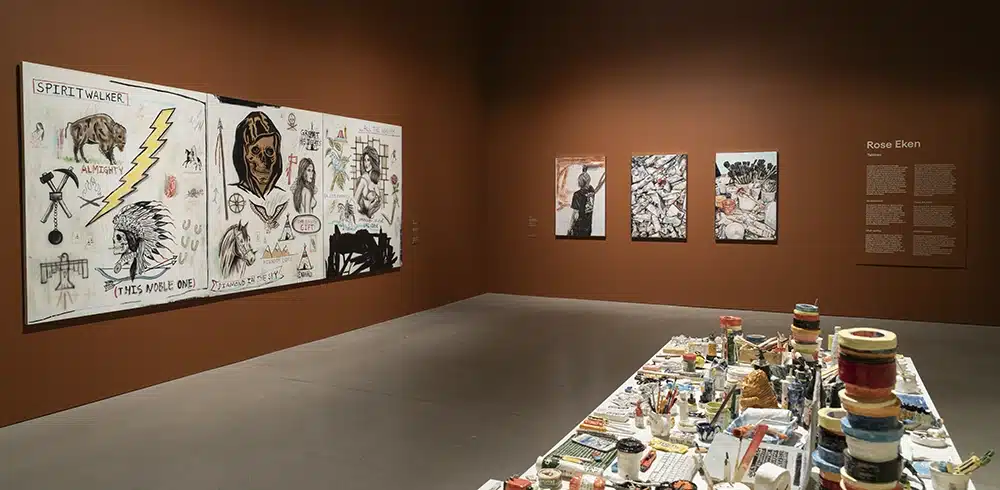
Favorites from the collection, ARoS 2026. Photo Mads Smidstup ©ARoS 2026
You probably know the feeling of standing in front of a work of art and suddenly being in a completely different place in your life. That's how it was for me when I first went through Favorites from the collection at ARoS. Some of the works I have seen before, some are still in my mind and are clearly pictured in my head even 10 years later. Others I am encountering for the first time. What they all have in common is that over the years they have become part of ARoS' history and of the visitors' own memories.
Curator Anne Mette Thomsen has collected the works without a fixed chronology and without trying to tell one unified story. Instead, you encounter a group of works that each contain their own world, which is felt from the very first artwork.
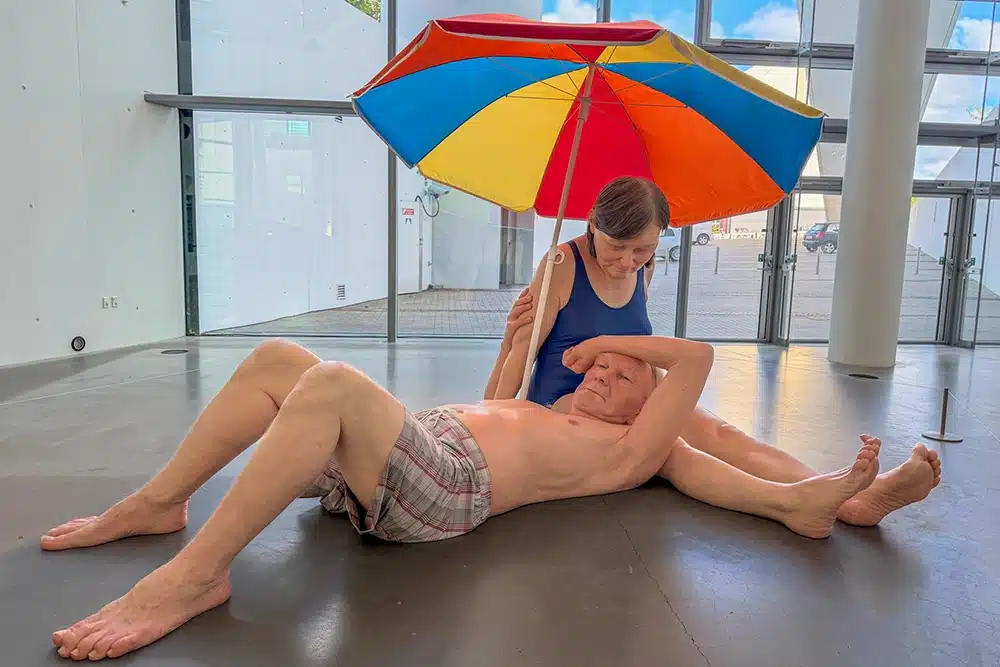
Couple under an Umbrella – Ron Mueck
Couple Under an Umbrella from 2013 depicts an elderly couple under a parasol. The figures are created exactly twice human size and you look at them for a long time before you reach them. Ron Mueck works hyperrealistically, but changes the scale so that the figures never become mere copies of life-size people.
The work shows the aging body without embellishment. You can see the skin, feet and the body's traces very close up. The large scale makes the small details striking and at the same time gives the experience something psychological. You quickly begin to imagine who the two people are and what their relationship entails.
The work is open to different readings. Anne Mette herself chooses to see tenderness in the way the couple is together, including in the placement of his head on her lap. I myself feel both something homely and also see bodies that have lived a long life. Other guests focus on details that may raise doubts about their relationship.
Couple Under an Umbrella comes to ARoS as part of an exchange between museums.
From September to March, Museum Voorlinden in the Netherlands will lend the work to ARoS, while ARoS will in turn send its own Mueck sculpture, Boy from 1999, to Voorlinden's anniversary exhibition Celebrating the Icons of Art. During the tours, you can also touch silicone casts of another Mueck work, which Voorlinden has made available, and there is a small niche where you can sit and read more about the artist.
Favorites from the collection, ARoS 2026. Photo Mads Smidstup ©ARoS 2026
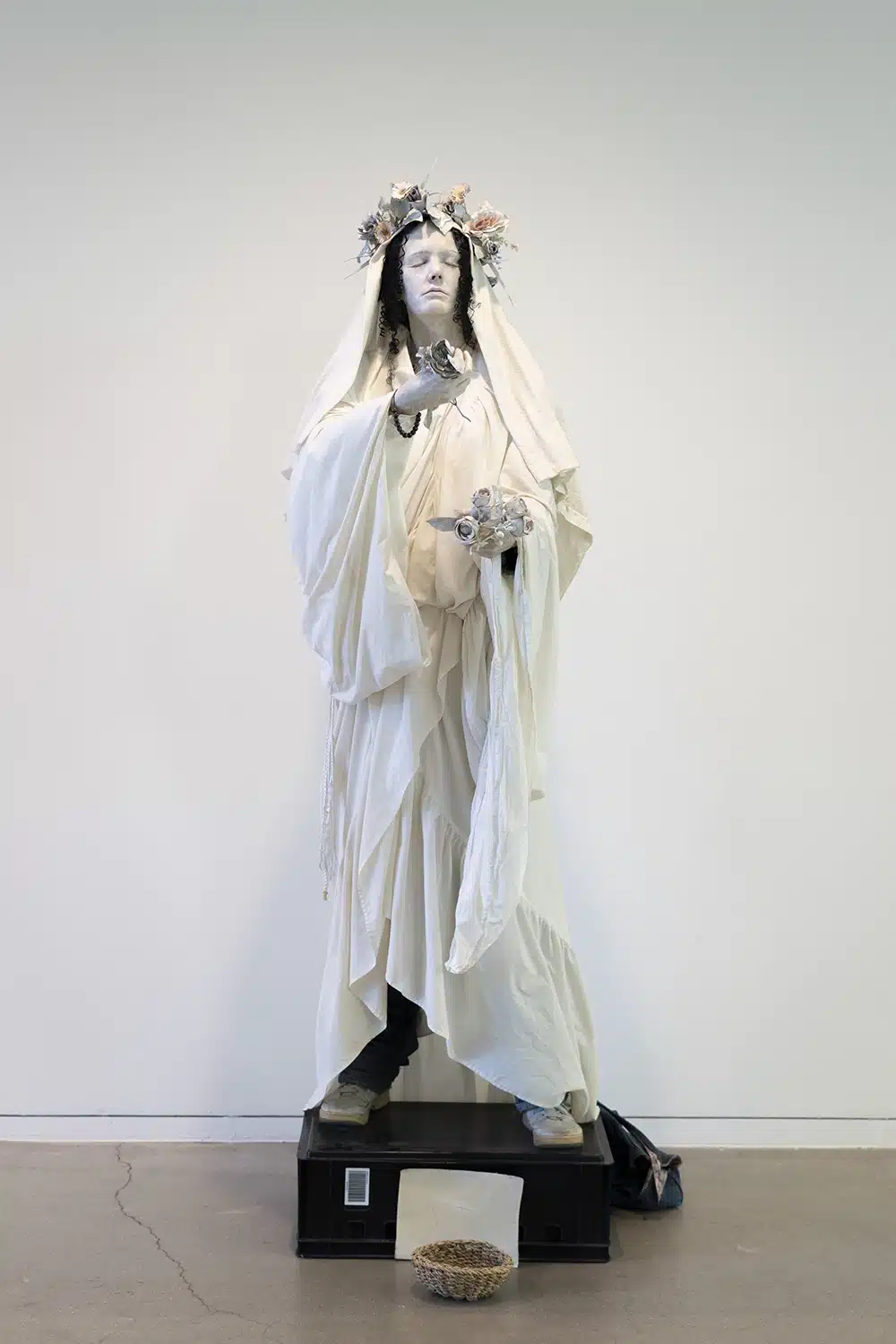
Flora – Rory Macbeth
Flora is a hyperrealistic sculpture by British artist Rory Macbeth. It has previously been displayed in ARoS' museum street and has also been shown outside the regular exhibition spaces.
The sculpture has amazed many visitors over the years because it looks like a real person. Back when many people carried cash on them, some were so convinced that they put money in her basket. Anne Mette says this with a smile, because the donations actually ended up making a small contribution to the maintenance of the collection.
She also says that shortly after she started at ARoS, she saw a letter written to Flora. The sender had apparently perceived her as a real person.
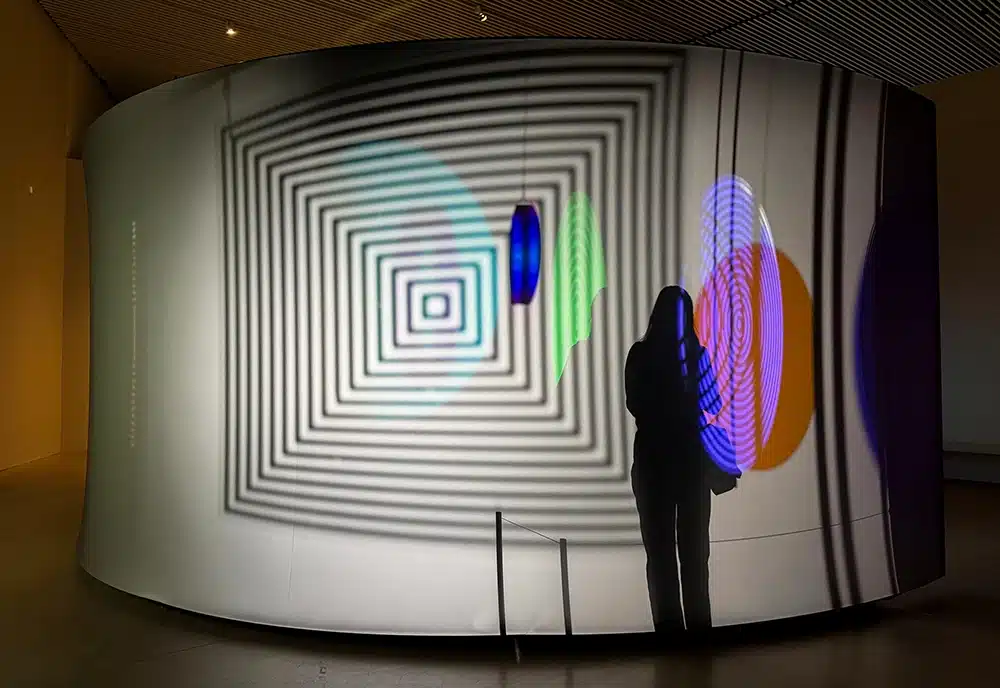
The inverted panorama house – Olafur Eliasson
Behind a round, closed screen, glass discs rotate, and colored light creates an image that is always in motion. From a distance, you see a calm, changing play of light, but if you walk behind the work and into the installation itself, you yourself become part of the optical universe. This fits with Olafur Eliasson's desire that the audience should not only see the effect, but also experience how the work works.
There is a hidden thought behind all that light and color. Eliasson has long been interested in how our senses help shape the world we experience, and here he draws inspiration from Goethe's theory of color. For Goethe, color was not a fixed, physical quantity, but something that arises in the very encounter between light, darkness, and the eye that sees. You feel that thought firsthand when you stand in the middle of The Inverted Panorama House.
The work joined ARoS' collection in 2011, the same year the museum's roof received its Your Rainbow Panorama, which is probably what most people associate with Eliasson.
Favorites from the collection, ARoS 2026. Photo Mads Smidstup ©ARoS 2026
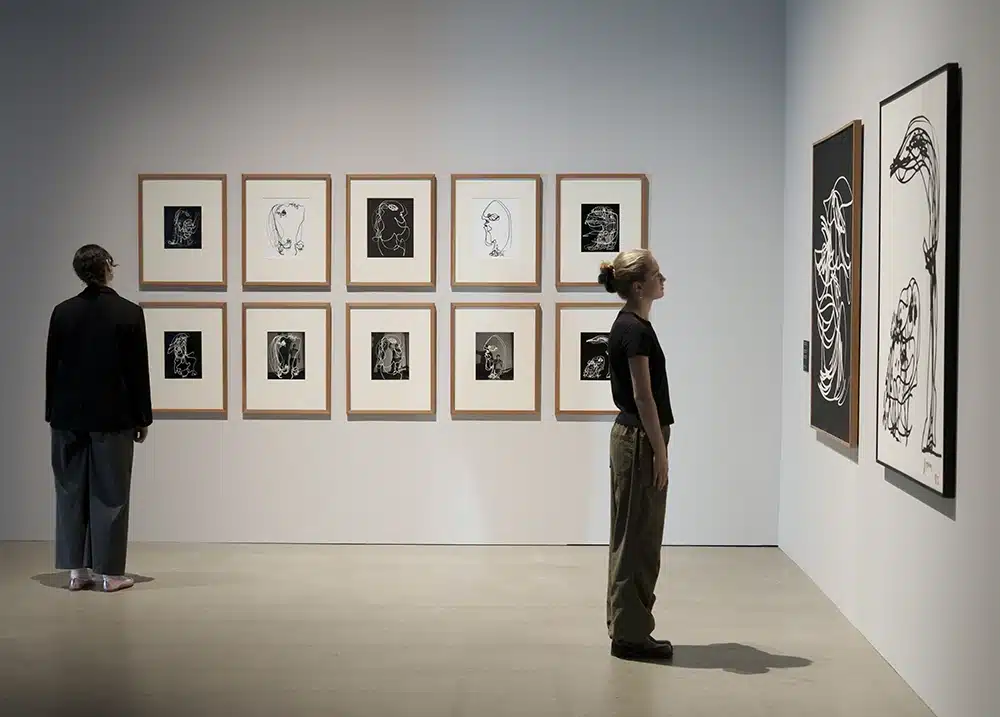
Light drawings – Asger Jorn
In a dark room, Asger Jorn stands with a flashlight in his hand. A long-exposure camera captures every movement, and the light leaves traces in the air, resembling a drawing that no brush has touched. The photographs show the path of light and Jorn himself as a shadow in the background of his own work.
The light drawings originated in 1953 in an experimental collaboration with photographer Poul Pedersen, who encouraged Jorn to try the technique. They resulted in a total of 21 drawings, created with a sketchbook as support along the way. Jorn is best known as a painter, but he was not afraid to expand the media of art and make the action and light itself part of the picture.
Camp Kitchen Hanne – Nielsen & Birgit Johnsen
Next you enter a video room, where you encounter a kitchen on the big screen. A peace line very close, romantic and gentle music, which together create an idyllic scene. Then the blinds are drawn up, and the war pours in. Helicopters fly, sandstorms rise, explosions echo from the TV and radio, and the idyllic scene is transformed into chaos. The women in the kitchen become activists, fighting with what they have at hand. Ninja throwing stars shaped like cookies, a vacuum cleaner and soapy water.
The video room alternates between showing Camp Kitchen from 2014 by Hanne Nielsen and Birgit Johnsen and Mahdokht from Women Without Men by Shirin Neshat. According to the tour, Camp Kitchen lasts approximately 22 minutes, while Mahdokht lasts approximately 12 minutes.
The room shows an important track in ARoS' collection, which is video art. Anne Mette has chosen the two works because they show both a Danish and an international track. Thematically, they touch on, among other things, women's rights, freedom of expression, war, rebellion and the way we communicate. Shirin Neshat's approach is described as poetic, while Hanne Nielsen and Birgit Johnsen are known for a more humorous approach.
You don't have to watch it from the beginning to get anything out of it. I spent a short time in the room and was left with an impression that still sticks with me.
A clip of the video art can be seen above.
Fucked Couple – Tony Matelli
Some works you remember long after you've left the museum. For me, this was one of them, already as a young teenager when I saw it for the first time. The work made a big impression on me at the time, and showed that art is not always something that should satisfy people.
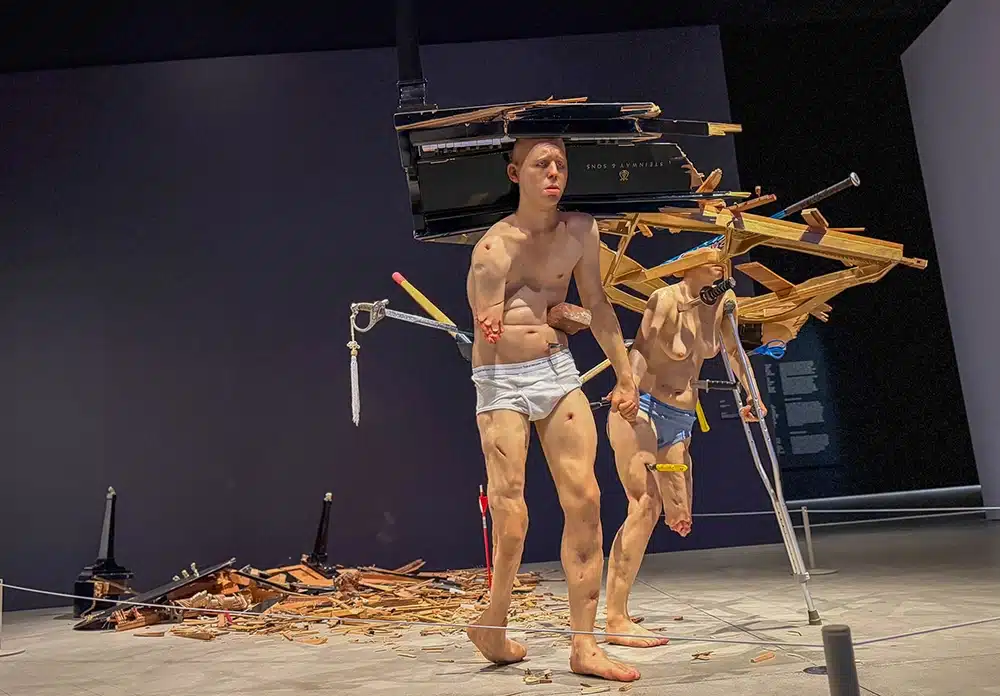
Tony Matelli's Fucked Couple is a large hyperrealistic sculpture of a couple who have been subjected to an almost absurd amount of violence. Their bodies are pierced and damaged, and a grand piano has seemingly crashed down on them. Yet they continue forward together.
For ARoS, the work is about, among other things, the vulnerable and grotesque human body. At the same time, there is a loving core. The couple holds each other's hands, and on one upper arm is the tattoo True Love Forever. No matter what has happened to them, they hold on to each other.
Anne Mette says that the work has played a significant role in ARoS' history. Many guests are deeply fascinated by it, while others find it violent. This makes the work ideal for describing the tension between repulsion, humor and tenderness.
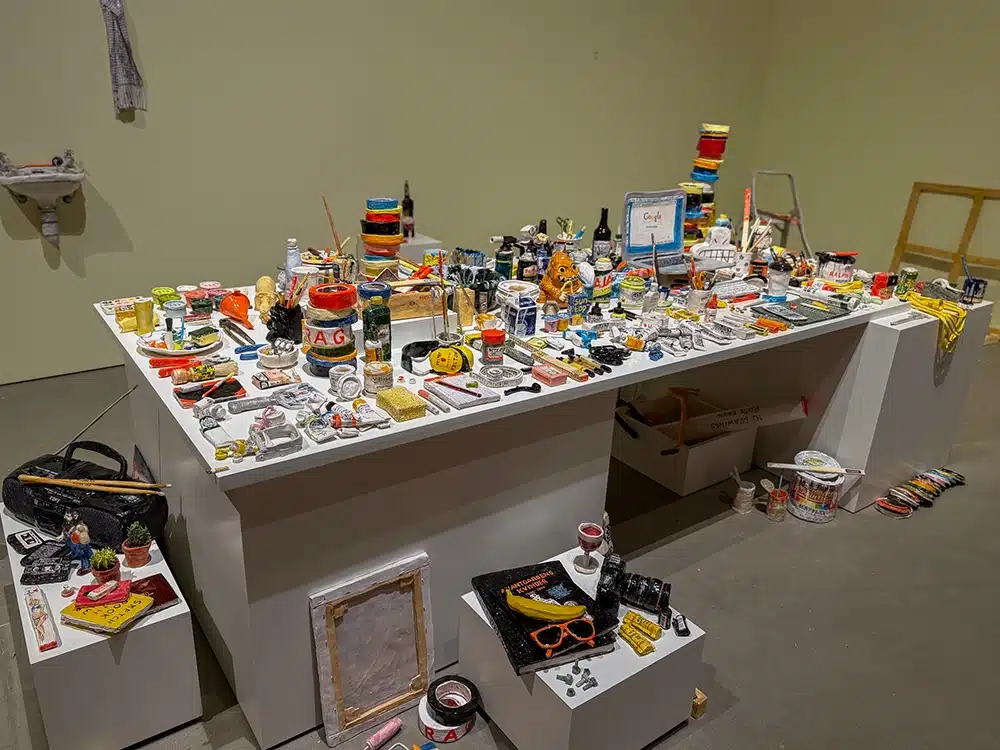
Tableau – Rose Oak
Tableau is a large installation by Rose Eken from 2015. It depicts a fictional artist's studio and consists of hundreds of small, handmade ceramic objects. The table overflows with brushes, paint tubes, rolls of tape, books, coffee cups, cigarette butts, wires, LP records, a can of mackerel and many other traces of a working studio. Each object is shaped by hand, glazed and fired.
As an artist, it's like looking into your own studio. The organized mess that is only chaotic to everyone but yourself. The ceramic computer with a search engine open to do research. The many open paint cans and the countless stacks of masking tape.
The work was created through research. Rose Eken contacted Danish and international artists and asked them to send photographs of their studios, workbenches and the things that were important to their work process or everyday life. From the images, she built a unified, fictional studio in ceramics.
Some of the objects contain small, personal stories. Among them is a bag of M&M's, because an artist eats them while he works. A QR code by the work leads to more material and a video where Rose Eken talks about the installation.
Wes Lang is part of the story surrounding Tableau. When ARoS previously exhibited his art, his entire studio was shipped from Los Angeles to Aarhus in a container and rebuilt at the museum. He painted a work in the studio at ARoS, which then became part of the collection.
For the current exhibition, ARoS has collected parts of Tableau from several owners, including V1 Gallery and Maltfabrikken in Ebeltoft. Rose Eken has also created new works based on photographs from the studio of the American artist John Copeland, including his paint tubes, brushes and a portrait of him. The exact number of objects is up for debate, as the number varies depending on who you ask. But there are undoubtedly hundreds.
Favorites from the collection, ARoS 2026. Photo Mads Smidstup ©ARoS 2026
Five Angels for the Millennium – Bill Viola
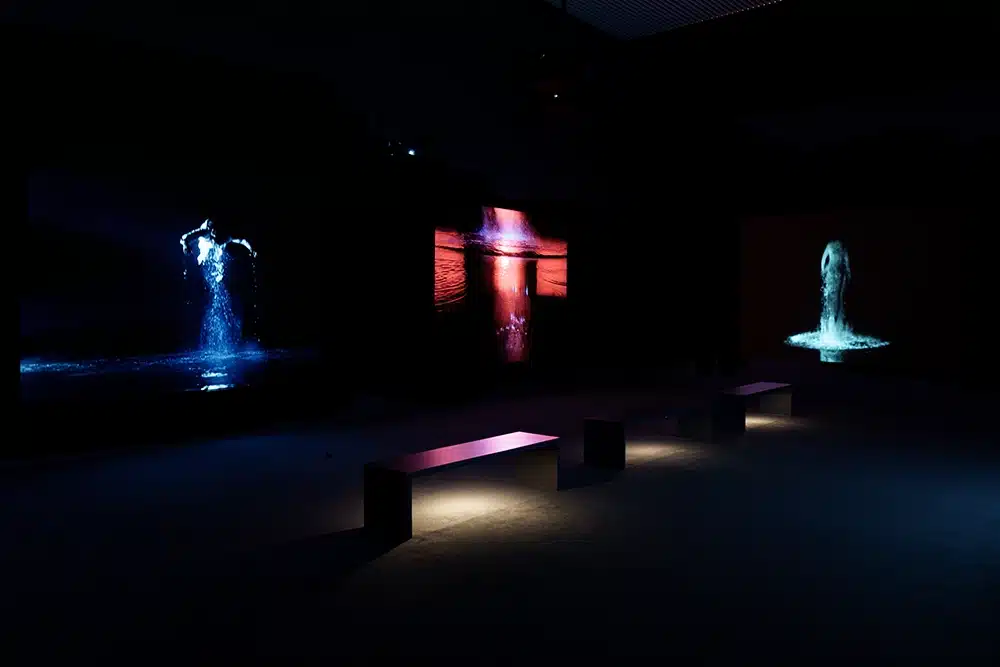
The space is large and dark and the sound is the first thing you notice. Heavy and distorted water surrounds you, as if you were below the surface. Five Angels for the Millennium from 2001 is a five-channel video projection that shows human bodies and water in highly lowered movements.
As a child, Bill Viola nearly drowned in a lake. He lay underwater and looked up at the light. The experience of light through the water later became important in his art. In Five Angels for the Millennium, water becomes an image of the transition between life and death.
The work is also an example of the large, spatial video art that has characterized ARoS' collection. The audience does not simply step in front of a screen, but into a combined installation of images, darkness and sound.
Vote for your own favorite
At the end, guests can vote for the work or artist they like best. The votes will be visible in the exhibition, so you can follow whether certain favorites begin to emerge over the fall and winter. The purpose is curiosity and asks which works influence guests today, which are experienced as most interesting, and are the audience's favorites the same as in the past?
The exhibition is called Favorites from the Collection, but the final favorite will not be chosen by the museum alone. Guests are invited to show which works still resonate in 2026.
In the exhibition you will find works by
- Olafur Eliasson
- Asger Jorn
- Shirin Neshat
- Hanne Nielsen & Birgit Johnsen
- Tony Matelli
- Michael Kvium
- Rose Oak
- Wes Lang
- Bill Viola
- Tony oursler
- Erik A. Frandsen
- Banana Al-Nasser
- Ron Mueck
- Rory Macbeth
The exhibition team
- Curator: Anne Mette Thomsen
- Exhibition producer: Oskar Mydtskov
- Exhibition architect: Kirstine Hulsrøj Jæger
- Exhibition construction: ARoS technical department
If you want to experience the exhibition yourself
- Location: ARoS Art Museum, Level 1
- Period: September 12, 2026 to August 29, 2027
- Curator: Anne Mette Thomsen
- Price: Free with annual pass or after paid admission
Articles
The Greenlandic polar explorer at Teater Svalegangen
SERIES AWARDS 2026 brought together the series industry at Aarhus City Hall
Bistro Solera on Aarhus Ø: French classics with a unique sea view
Barselona on Train: Melancholy that made the audience dance
When all of Aarhus lights up for Christmas
Authentic Japanese universe at Ramen Takumi in Aarhus
PHIL – Phil Collins tribute at Hotel Fuglsøcentret
Luxury brunch in Varna – a Sunday with a little extra of everything
The best burgers are found at Plant Food in Aarhus
Late summer off-season on Lesbos with Aarhus Charter
It happens in Aarhus
Culture
The Greenlandic polar explorer at Teater Svalegangen
SERIES AWARDS 2026 brought together the series industry at Aarhus City Hall
Maya – The Kingdom Under the Jungle at Moesgaard Museum

An Angry Woman at the Swallow's Nest Theatre

Iris Gold on stepping into the role of Tina Turner
TINA – The Tina Turner Musical in Musikhuset Aarhus: Simply the Best
Series Awards 2026: Here are this year's nominees
Move Your Mind Festival 2026 on Bora Bora
All The Feels on Bora Bora lets the emotions run wild
Afterglow at the Natural History Museum leaves its mark

Jane Austen's spirit lives on on Aarhus Theatre's stage

70s evening in the Old Town brings history to life

K7 Week in Aarhus 2026 with free culture for young people between 18-27 years old
